
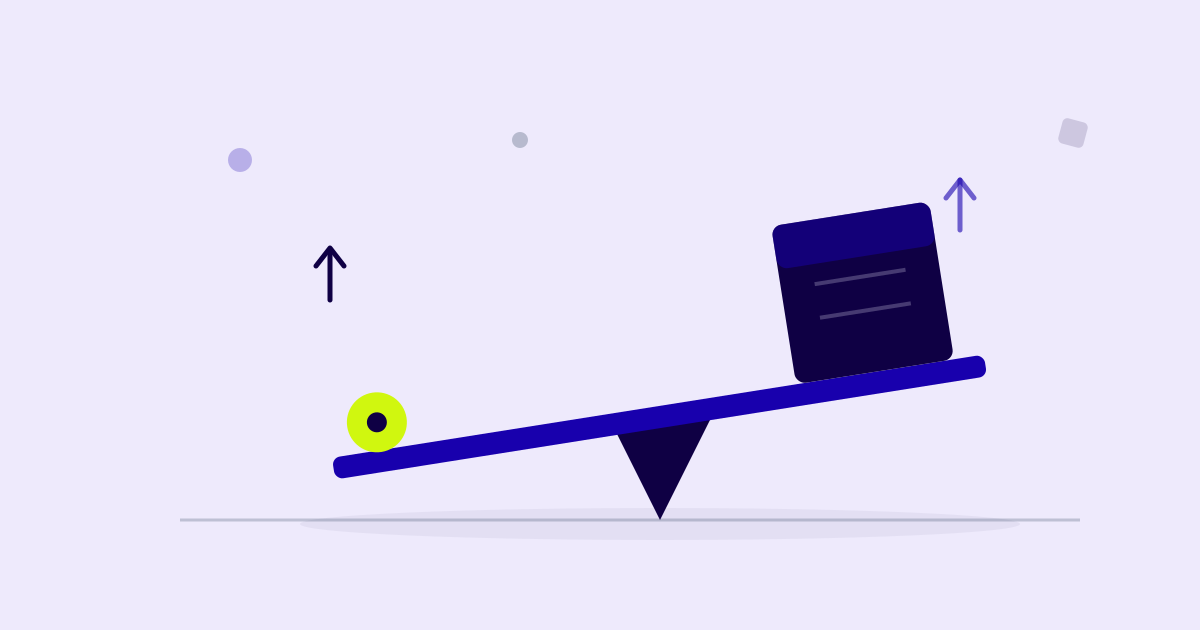
Sales enablement statistics keep pointing at the same expensive problem. Reps spend only 28% to 32% of their time actually selling, and 65% of the content marketing builds for them never gets used. Organizations that fix this report 49% higher win rates on forecasted deals. This piece breaks down where enablement pays off, and where most programs are still leaking value.
Sales Enablement Adoption and Market Size
Sales enablement statistics on adoption show a function that's gone from optional to standard in just a few years.
- 90% of organizations now have a dedicated sales enablement function, up 20% annually.
- 76% of organizations maintain a dedicated enablement function today, up from just 32% five years ago.
- 65% of organizations use dedicated sales enablement technology, up 5 percentage points from last year.
- The global sales enablement platform market is estimated between $4.2 billion and $6.6 billion in 2025, depending on the analyst firm. Every major estimate projects double-digit annual growth through at least 2031.
- Cloud deployment accounts for 82.18% of the sales enablement technology market.
- Only 43% of organizations have real analytics visibility into which enablement practices actually work.
- Only 25% of organizations track enablement's impact on revenue at all.
- Enablement most commonly reports into revenue operations (RevOps) at 39.4% of organizations, followed by sales at 25.4% and the C-suite at 16.6%.
Win Rate and Revenue Impact
This is where sales enablement statistics make the clearest case for continued investment.
- Organizations with formal enablement programs win 49% of forecasted deals, versus roughly 42.5% for those without a program.
- The most effective enablement programs outperform peers on win rate by up to 17.9 percentage points.
- Average training ROI for effective sales enablement programs runs around 353%.
- 81% of organizations believe sales enablement directly boosts revenue team efficiency.
- Teams using dynamic, technology-supported coaching post 28% higher win rates than teams without it.
- Battlecards alone contribute to 23% more competitive deals won.
- Effective enablement correlates with 27% higher customer lifetime value.
- Enablement teams with six or more members report 14 percentage points higher quota attainment than smaller teams.
- Reps using mobile selling tools sell 26% more than reps who don't use them.
Sales Enablement Statistics on Content Usage
Sales enablement statistics on content are some of the most consistent numbers in the field. The waste has barely moved in over a decade.
- 65% of marketing content goes completely unused by sales, a rate that's held steady for years.
- Some enterprise audits show non-usage rates above 80% once teams actually check.
- Forrester estimates $2.3 million is wasted annually per enterprise on content that never gets used.
- Sellers without proper enablement tooling spend an average of 10 hours a week just finding or revising content.
- Reps lose roughly 440 hours a year searching for or recreating content, nearly a quarter of a working year.
- 50% of all prospect engagement comes from just 10% of the content sitting in most enablement libraries.
- 84% of sales executives name content search and utilization as their top productivity improvement area.
- 40% of content gets recreated simply because reps can't find the original version.
- One enablement platform cut its content library by 76% and saw engagement climb from 4% to 55%, proof that curation beats volume.
A SaaS content marketing program built around what sales actually uses tends to close this gap faster than adding more assets to an already-bloated library.
Onboarding and Ramp Time
Ramp time is where sales enablement statistics show the clearest, most measurable return on a training investment.
- Typical B2B onboarding runs 3 months to basic buyer-readiness, 9 months to competence, and 15 months to top performance.
- Structured onboarding programs cut that ramp time by 33%, reaching productivity in 6 to 7 months instead.
- Sales enablement overall cuts onboarding time by 40% to 50% across the organizations that invest in it.
- Effective onboarding specifically decreases ramp-up time by 26%, according to earlier benchmark research.
- Without reinforcement, up to 70% of training content is forgotten within 24 hours, and 87% within a week.
- Organizations with highly effective sales training report 33.8% lower seller turnover than those with weaker programs.
- Enablement involvement in onboarding reduces rep turnover by 5 percentage points on its own.
Sales and Marketing Alignment
Alignment between sales and marketing shows up directly in enablement outcomes, beyond just how the teams get along.
- Sales professionals at aligned companies are 103% more likely to exceed their goals than those at misaligned ones.
- 61% of companies with a clearly defined sales enablement function report strong alignment between sales and marketing.
- 74% of leading companies name coaching and mentoring as the top priority for frontline sales managers.
- Between 50% and 90% of the B2B buying journey now happens before a prospect ever talks to a sales rep. A B2B SEO strategy is often what fills that pre-sales-rep stretch of the journey with the right content.
Teams without a dedicated analytics function often bring in a fractional SEO or growth partner. This connects the content side of enablement back to real pipeline data.
AI's Role in Sales Enablement
AI adoption inside sales enablement has moved fast, even though the return on it still varies widely by how well it's integrated.
- 75% of sales organizations are expected to run some form of AI-powered enablement by the end of 2026.
- AI adoption inside enablement workflows is up 156% over the past 18 months.
- AI tools deliver 26% better response quality and a 38% reduction in time spent on routine tasks.
- Reps completing 10 or more AI-assisted role-plays a year score 61% on live sales calls, versus 57% for reps completing fewer.
- AI-assisted onboarding can cut time-to-productivity by roughly 42%, though this figure varies by source and should be read directionally.
- AI-driven sales teams reduce overall cycle times by up to 20%.
- Gartner projects 30% of B2B sales cycles will run through digital sales rooms (DSRs) by the end of 2026.
- The global DSR software market reached $1.2 billion in 2024 and is projected to hit $6.5 billion by 2033.
Consistent brand and product positioning across these AI-assisted touchpoints connects directly to the kind of AI SEO work built for exactly this kind of consistency.
Bottom Line
Sales enablement statistics keep circling back to a simple gap between activity and usefulness. 65% of content marketing produces goes unused, and reps still spend more time hunting for materials than actually selling. Fixing that content problem alone would close a large share of the productivity most programs are still chasing.
Win rate data backs up the investment case clearly. Formal programs win 49% of forecasted deals against 42.5% for teams without one, and the highest-performing programs stretch that gap to nearly 18 points. Ramp time tells a similar story, with structured onboarding cutting new-rep productivity time by a third.
AI is starting to compress both problems at once, speeding up onboarding and improving content relevance in the same workflow. The programs seeing real returns aren't the ones buying the most AI features. They're the ones connecting AI directly into the systems reps already use every day.
Sources
PassiveSecrets – Accessed July 2026
Cirrus Insight – Accessed July 2026
SiftHub – Accessed July 2026
Federico Presicci – Accessed July 2026
Prospeo – Accessed July 2026
Prospeo – Accessed July 2026
Everstage – Accessed July 2026
Martal – Accessed July 2026
Digital Applied – Accessed July 2026
Sales Enablement Collective – Accessed July 2026
SalesSo – Accessed July 2026
AutoRFP – Accessed July 2026

Usama runs a boutique, revenue-focused SEO and AI search consultancy for B2B brands. He works with a capped number of clients each month, embedded as a senior fractional strategist. The goal is always the same: make organic a sustainable pipeline channel. When he’s not building search strategies, he’s probably watching cricket or learning more about coffee.
Follow for B2B marketing contentReady to turn AI search into a pipeline channel?
Tell me what you’re working on. In 30 minutes we’ll dig into your goals, where the gaps are, and what it actually takes to win on Google and AI search.


Trusted by B2B companies and SEO agencies on 4 continents
Learn more from my resources.

7 Best Fractional SEO Services for B2B SaaS in 2026
11 min read
10 best LLM SEO agencies for SaaS in 2026
14 min read
How to rank in ChatGPT search results: VISIBLE framework explained for B2B SaaS
14 min read

9 Best LLM SEO consultants in 2026: pricing, model, and who they fit
15 min read

10 Best Siege Media alternatives for B2B SEO in 2026
12 min read

10 Best B2B SaaS SEO Agencies and Consultants for Pipeline Growth in 2026
16 min read